
I’ve done fitness training with a lot of kids over the years, and I thought I’d try to summarise some key points from my experience.
From the outset, certain essentials must always be kept in mind. You need ongoing risk assessment of the location you are using, equipment used, and the particular characteristics or group dynamics of the children involved.
My work has focused mainly on running, exercises and martial arts. I’ve typically done one-on-one personal training, sometimes two together, and occasionally group training. I’ve worked mostly with boys, so it’s worth bearing in mind that girls’ needs may differ in certain areas.
Running
With running, I’m conscious that this is something most kids should be doing plenty of anyway, without the need for a trainer. So I try to challenge them with a variety of drills and games, and I’m able to draw from my experience of a range of sports to be quite creative with these. In other words, I prioritise quality over quantity.
At the same time, some children will prefer more endurance based challenges, and I’m happy to go with this approach too. Where possible, it’s great to be able to vary location, and run over a variety of terrain, to keep things interesting and motivating.
Whether you are focusing on speed or endurance, most kids will enjoy being timed so that they can compete against themselves or others. They will often enjoy trying to beat you, as the trainer. With some imagination you can set up challenges so that they have a chance to win.
I try to take part myself as much as possible, especially in one-on-one sessions, as appropriate. This enables the child to feel, at least for some of the time, like they are playing with a buddy, rather than being constantly told what to do. Every trainer has their own unique approach, and for me, my personality is very much about engaging with the individual and allowing them input into the process.
Exercises
With exercises, I try to keep in mind the largest muscle groups in the lower body, upper body and core. I choose a variety of exercises that will work all these groups in different ways, often together if possible, i.e. compound movements, with some isometrics. Generally I aim to keep a balance between push and pull type movements. I’ll typically explain something about the purpose/mechanics of each exercise, even with younger kids, and test them on their knowledge over time.
Where possible, I try to incorporate exercises into games, so that we are avoiding the monotony of repeated identical motions, which can often become a chore. In other words, I try to keep things fun. As for tracking progress, I think this is often best seen in terms of technique and knowledge, rather than number of reps or weight lifted. I also keep an eye on flexibility, which I try to develop more through the exercises themselves than through static stretching.
I tend to use mostly bodyweight resistance or light weights for kids’ exercises, since before puberty most strength gains are due to increases in muscle efficiency rather than size. It’s only when they are older, i.e. as teenagers, that heavier weights start to become more appropriate, in most cases. At all ages, plyometrics, i.e. jumps and hops, can be a good way to add more challenge while keeping to the bodyweight approach.
Martial Arts
Martial arts would require a full article of its own to introduce properly, as it is a more specialist area to include in training. Especially as there are a wide variety of styles, from striking to grappling, and from the forms based to the practical, with varying amounts of realistic sparring.
When I include martial arts, it’s either when parents think an element of self defence training would be useful for a child’s confidence, or for when kids need to improve all-round toughness for a contact sport like rugby or football. I draw mainly from my background in grappling (judo and jiu-jitsu / submission wrestling) and this opens up a whole new range of motions for compound exercises, isometrics and core work – often bringing an extra injection of speed too.
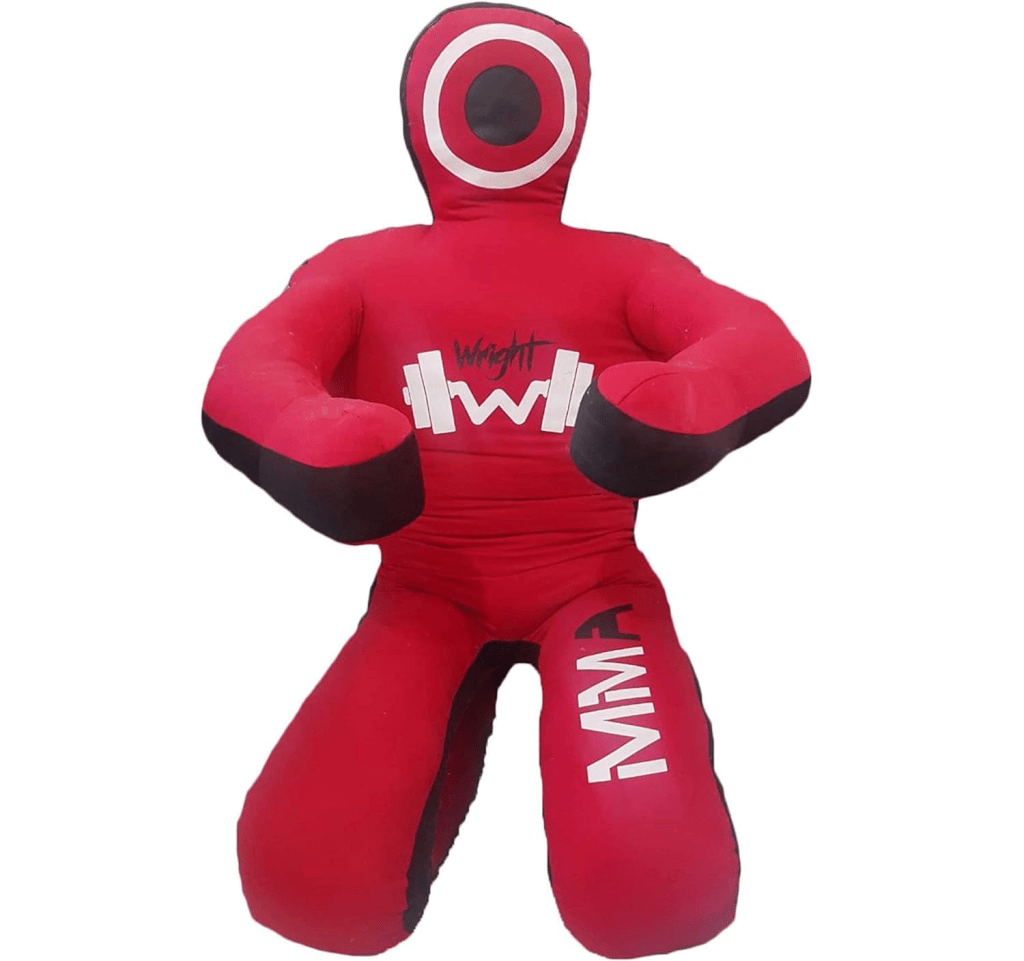
Using the grappling dummy, pictured above (I call him “Dumble”) is great for demonstrating moves, and giving the child a similar sized partner for drills in a one-on-one session. It also enables more games, e.g. timing each other in turn, to see who is faster at closing the distance to secure a certain move on the dummy.
Playful Training
In closing, whatever the skills and attributes you are aiming to develop, I would definitely emphasise keeping a playful approach. If kids are enjoying the session, they will typically be more motivated to work on skills, and push themselves harder to improve.
 Chris Gibbs Fitness
Leave a comment