It was the early 1990s… I was living in Moseley in south Birmingham, and in my last year of primary school. I was very good academically, but also loved exercise and the outdoors. I was the second fastest runner in my class, and naturally good at most sports that I tried.
As a creative, independent-minded type, I was wary of team sports and generally being made to take things too seriously. So my organised sports training was mainly limited to tennis and squash. But I would do a lot of exercise at home as well.
I was lucky that our house had quite a big garden, and I spent a lot of time playing in it on my own, when I wasn’t with friends (my older sisters had left home by this point). I would kick a football around, use the climbing frame and tyre swing, bounce on a pogo stick, and build dens. I would even do my own mini-athletics sessions: timing myself for various sprint/shuttle challenges, jumping over makeshift hurdles, throwing a javelin (bamboo stick!) and more.
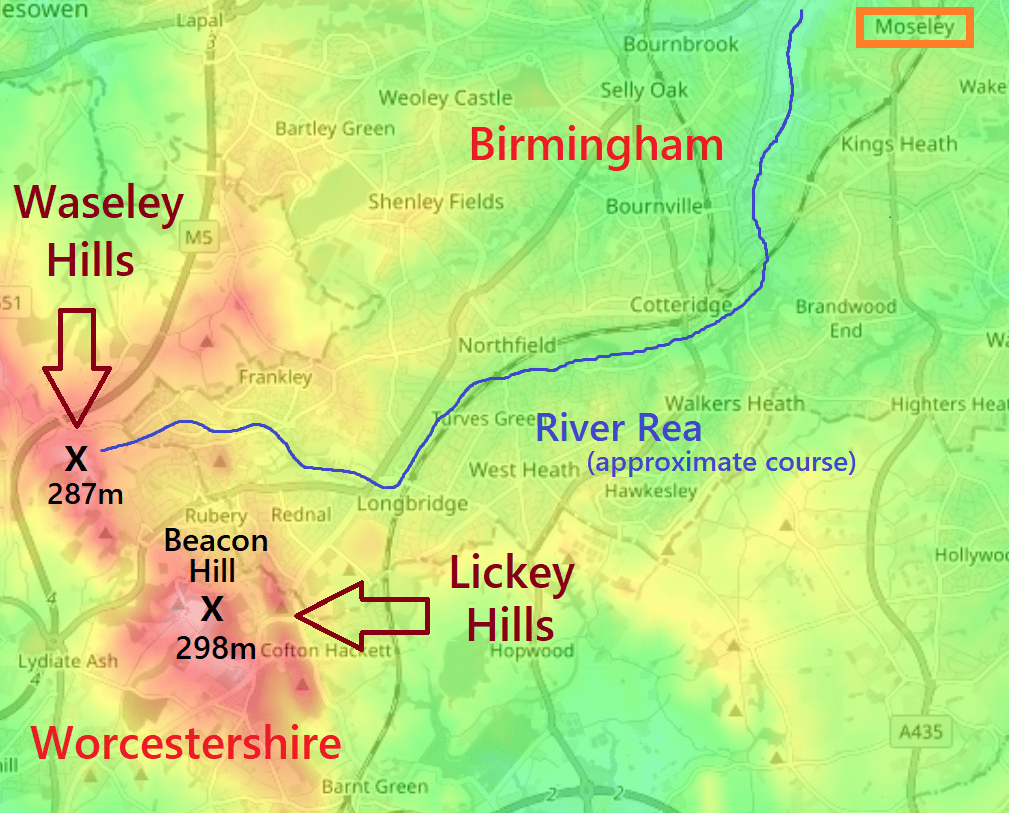
Our family enjoyed walking, including long hikes in places like Wales, the Peak District and the Lake District. When I was 10, we had taken part in a sponsored walk from Moseley along the River Rea to its source in the Waseley Hills, on the southwest edge of Birmingham. This made me feel more connected with the local hills, especially as I could actually glimpse them from my window at the top of the house, which was on a southwest-facing slope.
My parents were selling the house, which made me very sad, but then I also became excited about the location of the new house, especially after we visited it. It was on the Lickey Hills – the next range of hills along from the Waseleys. The Lickeys have a road on their highest ridge, unlike the Waseleys, and this is where the house was – at 287 metres or 940 feet above sea level! Exactly the same height as the top of the Waseleys, and you could walk even higher to the summit of Beacon Hill at 298 metres or 978 feet.
I had already been fascinated by geography and meteorology for a few years, and so the prospect of living on a hill high enough to change the weather really caught my imagination. I was also inspired by how much wilder it was likely to be than the parks in Moseley, with deeper woods, farmland, and rarer wildlife like deer.
In fact, our new house was directly opposite a path into the woods of the Lickey Hills Country Park. Even though our previous house had backed onto woods and fields (along the River Rea from Cannon Hill Park), it felt like we were moving to a new frontier!
Back in Moseley, I pored over any map I could get my hands on, and the most fascinating was the Ordnance Survey map of Birmingham and the area to its southwest. This showed elevation contours, as well as major footpaths. So I was able to get a better sense of the steepness of the hills, possible routes to explore, and how the different hills in the area connected/compared.
Another reason that the urban-to-rural move caught my imagination was that I had the symbolism of it imprinted in my mind by books that I had read. One book series in particular involved a very similar journey. It was the Pentecost trilogy of childen’s books by W.J. Corbett, which was about the adventures of a harvest mouse colony who leave their polluted and unsafe home in the city to find a new homeland… in the Lickey Hills! The third book was actually entitled “Pentecost Of Lickey Top”, and published in 1987.
The more famous Lord Of The Rings trilogy by Tolkien was just as relevant. Tolkien also lived in Moseley when he was 11! The area where he used to play around the woodlands of Moseley Bog and Sarehole Mill is now designated as the Shire Country Park. These places inspired the “Old Forest” and the Hobbiton mill respectively.
Tolkien then had to move to Rednal, at the foot of the Lickey Hills, when he was 12, as his mother was very ill and a more rural location was considered better for her health. Sadly she died a few months later, and Tolkien and his brother were orphaned. They ended up back in Birmingham under guardianship. So it was only a short stay in Rednal, but the brothers spent a lot of time exploring the Lickey Hills, and Tolkien had further connections with the area as a teenager and young adult. The Lickey Hills clearly provided heightened inspiration for urban-rural contrasts in his writing.
This post has already become longer than I expected, and we haven’t even got to the house move yet! So I will stop here, and aim to write a Part 2 soon…


Leave a Reply